
Expansive Soil
With significant real estate development Washington in the past 20 years, the problems caused by expansive soil have become painfully obvious. Many people have literally lost their homes due to extensive damage and the high costs of repair. In some cases, class action lawsuits have been brought against builders and/or developers for failure to follow the recommendations of their soils engineers, or for failure to properly disclose the potential risks associated with purchasing a home built on expansive soil.
Map of Washington Showing Swell Potential of Reactive Soils
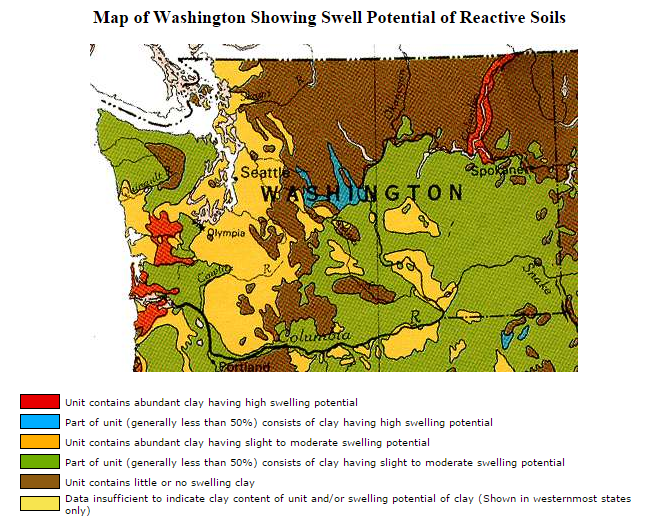
“Bentonite” is a term commonly used to describe expansive soil. Expansive soils such as clay, claystone, and shale will “swell” in volume when wetted and will shrink when dried. This volumetric expansion and contraction can cause houses and other structures to heave, settle, and shift unevenly, resulting in damage that is sometimes severe.
Minor damage from expansive soil movement can sometimes be repaired for less than $5,000. However, major damage can cost $30,000 to $50,000 and occasionally up to $100,000 or more to repair!
Geotechnical engineering and structural engineering have come a long way in the last 20 years, and specific foundation systems have been devised to help counteract some of the problems inherent with expansive soils. However, the risk of damage to homes can be minimized but cannot always be eliminated.
Here are several good reasons for having your home inspected by a trained professional:
- There are homes in Washington built on expansive soil. A trained professional knows what to look for to determine if expansive soils are potentially present.
- Expansive soil can vary significantly in its destructive potential from one area to another, even from lot to lot! An experienced professional can alert you to issues and direct you to a soils expert who can help project the potential future impact of expansive soil on a given home.
- Some types and styles of construction are more susceptible to damage from expansive soil than others. A professional can counsel you on the home in question, to better understand the risks.
- Expansive soils can be expected to eventually “stabilize” under certain conditions, but will not stabilize under others. A professional will discuss low cost improvements that will help promote stability.
The beginnings of expansive soil related movement can be difficult for the untrained eye to recognize. The experienced professional is trained to recognize “early warning signs” that foretell of future problems.
What’s a homeowner to do? Educate yourself about expansive soils, of course. Here are few tips to get you started:
Read the soil conditions report.
Before you buy a new house or a lot in a new subdivision, ask to see the soil conditions report. In the mid-80s Washington passed a consumer protection law requiring one for all new construction.
Ask about the type of foundation.
Expansive soils require special foundations. Basically, concrete pillars are set down onto bedrock. Then concrete beams are placed atop the piers. A thick cardboard spacer can be placed under the beams so that if the soil heaves, the spacer will be crushed but the floor won’t move. The walls, especially in finished basements, are separated by 2-4 inches from the concrete slab with small spikes for the same reason.
Learn about these techniques before finishing your basement.
To save money, homeowners often finish their own basements. That’s fine, but if your house if built on expansive soils, you’d better incorporate the above-mentioned construction techniques or you’ll end up with cracked basement walls or floors.
In older homes, look for wide or uneven foundation cracks.
If your home was built before the soils testing requirements of the ’80s and you’re concerned about expansive soils, you probably only need to worry if you find wide (a quarter inch or more) or uneven (one side higher than the other) cracks. Hairline cracks are usually caused by normal settling. If you’re unsure, call in a professional inspector or soil engineer for his analysis.
Ensure proper drainage away from the house.
Expansive soil conditions are made worse when water collects around the home’s foundation. Rainfall should run off the property as fast as possible following a storm. Rain gutters and downspouts should direct water away from the house, discharging it no closer than 3 feet from the foundation.